
Wednesday, April 22, 2009
Hazels all planted
On April 17 we finished planting all the hazels! The final two varieties to go in were Geneva and Santiam. This was also Joanie's birthday, so we celebrated both achievements with chocolate cake.

Saturday, April 11, 2009
Planting Hazels!
After many months of talking about and waiting for our hazelnut trees, we finally have most of them planted. All of this was preceded by several weeks of digging holes and making cages out of hardware cloth. We wanted to give our trees a good start, so we dug large holes - about 3 ft wide and 18 inches deep.
 And then we added lots of compost to the soil to refill the hole. The compost will provide the trees with nutrients and will also help them retain water during the summer.

We're planting 8 varieties of hazelnuts from two different nurseries. The first batch arrived on March 31: bare-root 2-yr-old layered clones of Tonda di Giffoni, Halle's Giant, Gamma, Delta, and Yamhill. It's very important that the bare roots don't dry out, so we dipped the roots in a gel that helps keep them wet. We then heeled them into our pile of finished compost. They stayed pretty happy there, which gave us a week to get them into the ground -- which we needed, since there were 38 to plant in the first batch!
 We partially refilled each hole with a mixture of soil and compost, and we made sure that the collar of each tree was level with the ground. We spread out the roots, held the tree straight, and started filling the hole with compost and soil.
 For protection from the vicious Glendale rabbits (who ate the tops off our first four hazels over the winter), we constructed 3-ft-high, 6-inch-diameter cages out of 1/2-inch hardware cloth. We buried the bottoms of the cages a couple of inches as we refilled the holes. Between those and the family of stray cats nearby, we're hoping our trees will be safe from rodents.

Hazelnut trees naturally grow with multiple trunks coming up from the base, which can make it difficult to walk through the orchard for harvesting and maintenance. Our tree cages will help us train them into single-trunked trees. Pruning some of the buds off will also help the trees put more of their energy to establishing a healthy root system.
 According to our soil test, we have pretty poor soil to work with - low in organic matter, pH around 5, and low in nitrogen, phosphorus, calcium, and potassium. Hazels like a rich soil (higher pH), so we added about 1/2 c of calcitic lime to each hole. (We will also top-dress with about 10 lbs of lime per tree.) We also added 1/2 c of rock phosphate to each hole, a slow-release phosphorus source to stimulate root growth.
Most of what we're adding is slow-release, and we hope that periodic top-dressing with compost and manure will help stabilize the pH and keep the levels of nutrients in the soil high. It will take time and lots of care to get there, though.
 We also added two products from Oikos Tree Crops. The first is a root-zone "tea bag" made from fish, alfalfa and feather meal (yum) and potash inoculated with mycorrhizal fungus. The second is a slow-release macro-micronutrient tab which dissolves over the course of two years. We have no idea if they'll work, but we're hoping they'll help to make up for some of the initial nutrient deficiencies of our soil.
 Finally, we gave each tree a good watering-in (Joanie at the hose, here). It's been a rainy spring so far, which helps the chances for our trees establishing themselves properly.

We're expecting to lose some trees, particularly the Yamhill and Halle's, which had very poorly-developed roots when they arrived. We've been watering them every day it doesn't rain, and soon we'll mulch them to protect them from grass. After that we'll install a drip irrigation system that will give the trees a steady supply of water over the summer.

Wednesday, March 25, 2009
Starting
Spring is finally here after a long winter of getting settled in Glendale Springs, planning our garden, and ordering everything we'll need to get started.
For our first year we'll be planting 50 hazelnut trees, several rows of strawberries, and working on a small garden. We're going to be growing potatoes, squash, beans, and smaller amounts of other kitchen vegetables as well. We're hoping to sell some of our produce at the Ashe County farmer's market in West Jefferson.

One of the first things we wanted to do with our garden is improve the soil. Normally we would do this by collecting and composting material throughout the year and adding it to our growing space. Since we were new this year, we ended up buying a pile of finished compost, which will let us get off to a good start.

We also need compost for our trees. Planting our trees in pockets of compost will help them get access to nutrients, grow healthy roots, and will help the soil retain moisture. Soil with a healthy amount of organic matter will also help moderate the pH.

But we will also have to start making our own compost -- for next year and for later this season. Next to Kristen is a pile of goat bedding and manure, courtesy of Lon & Carol Coulter's goat dairy in Jefferson. We will bulk it up with leaves and turn it regularly so it breaks down evenly. Kristen is mixing a bucket of peat to make soil blocks for our vegetables.

Soil-blocking is a way of starting your vegetable garden without pots. A soil block recipe is very similar to a potting mix recipe, and we hear that they are sometimes interchangeable. The soil block mix is compressed into cubes using a metal tool called a soil blocker. We ordered ours (as well as most of our seeds) through Fedco. One of the nice things about soil blocks is that they can be planted directly into the ground without disturbing the roots of the young plant.
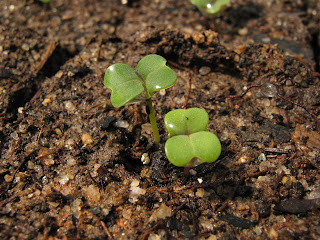
Here is a pair of pak choi starts emerging from a soil block. It looks like they're almost as eager to get started as we are.
For our first year we'll be planting 50 hazelnut trees, several rows of strawberries, and working on a small garden. We're going to be growing potatoes, squash, beans, and smaller amounts of other kitchen vegetables as well. We're hoping to sell some of our produce at the Ashe County farmer's market in West Jefferson.

One of the first things we wanted to do with our garden is improve the soil. Normally we would do this by collecting and composting material throughout the year and adding it to our growing space. Since we were new this year, we ended up buying a pile of finished compost, which will let us get off to a good start.

We also need compost for our trees. Planting our trees in pockets of compost will help them get access to nutrients, grow healthy roots, and will help the soil retain moisture. Soil with a healthy amount of organic matter will also help moderate the pH.

But we will also have to start making our own compost -- for next year and for later this season. Next to Kristen is a pile of goat bedding and manure, courtesy of Lon & Carol Coulter's goat dairy in Jefferson. We will bulk it up with leaves and turn it regularly so it breaks down evenly. Kristen is mixing a bucket of peat to make soil blocks for our vegetables.

Soil-blocking is a way of starting your vegetable garden without pots. A soil block recipe is very similar to a potting mix recipe, and we hear that they are sometimes interchangeable. The soil block mix is compressed into cubes using a metal tool called a soil blocker. We ordered ours (as well as most of our seeds) through Fedco. One of the nice things about soil blocks is that they can be planted directly into the ground without disturbing the roots of the young plant.

Here is a pair of pak choi starts emerging from a soil block. It looks like they're almost as eager to get started as we are.
Subscribe to:
Posts (Atom)